QpiAI opens ‘Asia’s largest’ quantum chip foundry, eyes 10,000-qubit processors
Indian quantum startup QpiAI has opened what it calls Asia’s largest quantum chip foundry, aiming to accelerate advanced chip-making locally. Founder-CEO Nagendra Nagaraja said the company has invested $20–25 million and plans an additional $10–15 million.
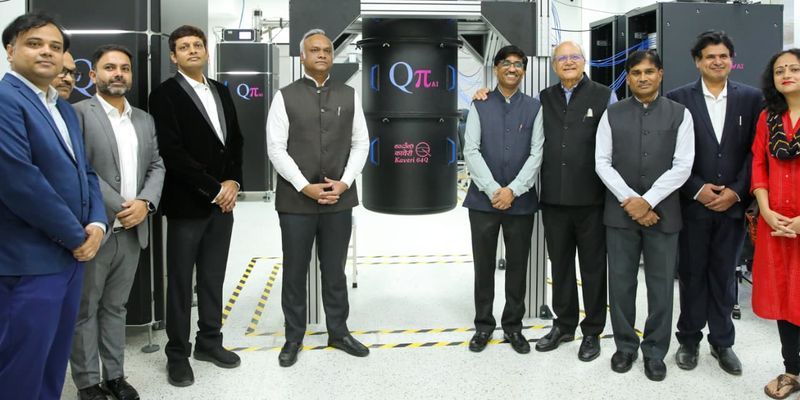
QpiAI has announced the opening of what it describes as **Asia’s largest quantum chip foundry**, marking an ambitious step for India’s deep-tech startup ecosystem. The Bengaluru-headquartered company says the new facility will support its longer-term goal of building **quantum processors at the 10,000-qubit scale**—a milestone that, if achieved, could strengthen India’s role in next-generation computing hardware.
The company’s founder and CEO **Nagendra Nagaraja** told *YourStory* that QpiAI has already invested **$20–25 million** in setting up the facility, and plans to invest a further **$10–15 million**. While the company did not share a detailed timeline for the 10,000-qubit target in the available information, the announcement signals a clear intent: to build advanced capabilities in quantum hardware manufacturing within the region.
A manufacturing push for quantum hardware Quantum computing is widely viewed as a frontier technology with potential applications across materials science, chemistry, optimisation, and secure communications. However, progress depends not only on algorithms and software, but also on the ability to design and fabricate increasingly capable quantum chips.
By opening a dedicated foundry, QpiAI is positioning itself to address a key gap: **specialised fabrication infrastructure** for quantum processors. Globally, quantum chip-making requires stringent control over materials, device architecture, and fabrication processes—areas where dedicated facilities can help teams iterate faster and test new approaches more reliably.
Although QpiAI’s claim of “Asia’s largest” is the company’s own description, the underlying message is straightforward: the startup is investing meaningfully in **long-term physical infrastructure**, which is often one of the hardest parts for early-stage deep-tech firms to build.
Investment, scale and a clear technical ambition In capital-intensive sectors like semiconductors and quantum hardware, investment levels often indicate both seriousness and staying power. Nagaraja’s comments suggest QpiAI is committing resources in stages—**$20–25 million already invested**, with **another $10–15 million planned**—to expand capability over time.
The stated target of **10,000-qubit processors** also reflects a focus on scale. In quantum computing, higher qubit counts are frequently discussed as a pathway to more powerful systems, although practical usefulness also depends on factors such as stability, error rates, and the ability to run meaningful workloads. QpiAI’s announcement, therefore, can be read as a directional milestone: the company is setting a high bar for what it wants to engineer, while building the manufacturing base it believes is needed to get there.
For India’s startup ecosystem, this kind of move can be encouraging in two ways. First, it demonstrates that complex, science-led ventures are willing to take on infrastructure-heavy bets domestically. Second, it adds momentum to a broader national conversation around advanced computing and hardware innovation.
What this could mean for India’s deep-tech ecosystem A quantum chip foundry is not only a facility—it can become a platform for talent development and ecosystem collaboration. As more engineers and researchers gain exposure to chip fabrication workflows, the spillover benefits can include stronger supplier networks, more specialised skills, and improved readiness for adjacent areas such as precision manufacturing and advanced electronics.
QpiAI’s announcement also arrives at a time when India is increasingly focused on building technology capabilities that are strategic and future-facing. While the company’s plans will ultimately be judged by execution and outcomes, the opening of a dedicated foundry is, at minimum, a concrete step that can help anchor quantum hardware work closer to home.
**Why it matters:** Building quantum chip-making capacity in India can help move the country from being a consumer of frontier technologies to a contributor—supporting high-skill jobs, advanced research, and the long-term competitiveness of India’s deep-tech ecosystem.
